
In the rapidly evolving landscape of digital business, the term „AI” is ubiquitous. It’s brandished as the solution to every problem, the key to unlocking unprecedented growth, and the future of productivity. However, this broad-stroke application of the term often obscures a critical distinction that can make or break a company’s technological strategy: the difference between an AI tool and an AI system. While both leverage artificial intelligence, their purpose, scope, and impact on a business are worlds apart. Understanding this difference is not just an academic exercise; it’s a fundamental prerequisite for making strategic investments, building scalable operations, and truly harnessing the power of automation.
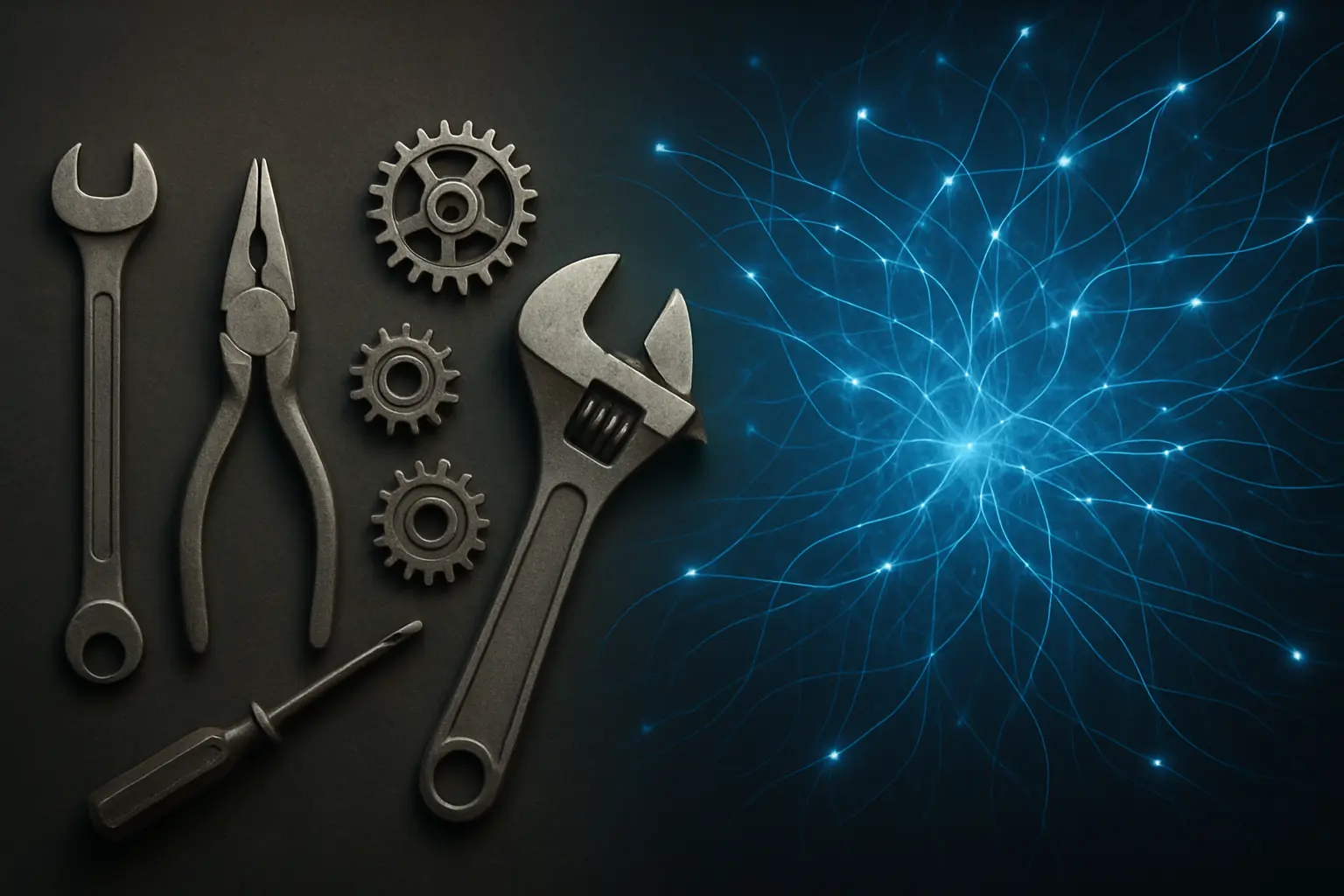
An AI tool is often a single-purpose application designed to assist with a specific task. Think of a carpenter’s hammer—it’s incredibly effective for driving nails, but you wouldn’t use it to saw a board. Similarly, an AI content generator, a social media scheduler, or an image background remover are powerful assistants in their own right. They enhance individual productivity and solve isolated problems efficiently. On the other hand, an AI system is more like the entire workshop. It’s an integrated network of components, processes, and data flows that work in concert to manage a complex, end-to-end function. It doesn’t just assist with a task; it automates and optimizes an entire workflow, learning and adapting over time. This post will delve deep into this crucial distinction, exploring why integrated AI systems ultimately outperform a collection of isolated tools for businesses aiming for sustainable, scalable growth.
Table of Contents:
- Defining the Core Concepts: AI Tools vs. AI Systems
- The Practical Implications: Why This Distinction is Crucial for Business
- Strategic Implementation: Moving from Isolated Tools to an Integrated AI Ecosystem
Defining the Core Concepts: AI Tools vs. AI Systems
To navigate the AI landscape effectively, we must first establish a clear and functional vocabulary. The terms „tool” and „system” are often used interchangeably, leading to confusion and misguided strategies. Let’s dissect each concept to understand their unique characteristics, functionalities, and limitations.
The Nature of an AI Tool: The Specialist Assistant
An AI tool is best understood as a specialized application designed to perform a narrow, well-defined task. Its primary function is to augment human capability, making a specific process faster, easier, or more effective. These tools are typically user-driven, meaning they require direct input and instruction to operate. They are the digital equivalent of a specialist’s instrument, powerful in their designated domain but limited in scope.
Consider these common examples:
- Content Generation Tools: Applications like Jasper or Copy.ai can produce blog posts, ad copy, or social media captions based on a user’s prompt. They excel at the single task of writing but do not manage the entire content lifecycle of planning, approval, publishing, and performance analysis.
- Image Editing Tools: A service that removes the background from a photo or an AI avatar generator performs a specific visual task with high precision. It solves one piece of the creative puzzle.
- Grammar and Style Checkers: Grammarly is a perfect example. It assists a user in improving their writing but doesn’t understand the strategic purpose of the document or its role in a broader marketing campaign.
- Transcription Services: AI-powered services can convert audio or video files into text with remarkable accuracy. This is a discrete task that serves as an input for other processes, such as content creation or meeting analysis.
The defining characteristic of an AI tool is its isolation. It operates within its own silo, processing the data it’s given and producing an output. The responsibility for integrating that output into a larger workflow falls entirely on the human user. You might use one tool to write an article, another to create a featured image, and a third to schedule it on social media. While each step is enhanced by AI, the process remains a manual chain of disconnected tasks.
The Architecture of an AI System: The Integrated Powerhouse
An AI system, in stark contrast, is a holistic, multi-component architecture designed to manage an entire business function or workflow. It’s not just a single application but an interconnected ecosystem of technologies, data pipelines, and automated processes. While it may incorporate various AI „tools” as components, its true power lies in their integration and orchestration. A system is designed for autonomy, scalability, and continuous improvement through data feedback loops.
Key characteristics of an AI system include:
- Integration: It connects with multiple data sources, such as your CRM, analytics platform, and email marketing service, to create a unified data environment.
- Workflow Automation: It automates a sequence of tasks that would otherwise require manual intervention and the use of several disparate tools. For example, it can identify a high-value lead, score them based on behavior, assign them to a sales rep, and trigger a personalized email sequence—all without human input.
- Data Feedback Loops: A true system learns from its outcomes. It analyzes which email sequences lead to conversions, which customer segments respond best to certain ads, and uses that data to automatically refine its future actions.
- Holistic View: It provides a comprehensive, end-to-end view of a business process, from initial customer contact to final conversion and retention. This is something a collection of tools can never offer.
Examples of AI systems include modern Customer Relationship Management (CRM) platforms like HubSpot or Salesforce, which use AI for lead scoring, predictive analytics, and chatbot automation. Full-suite marketing automation platforms are another prime example. They don’t just schedule posts; they manage multi-channel campaigns, segment audiences in real-time, personalize customer journeys, and provide integrated analytics—a comprehensive solution provided by firms like MarketingV8.

The Practical Implications: Why This Distinction is Crucial for Business
Recognizing the difference between a tool and a system is more than a semantic debate; it has profound strategic consequences for a business’s efficiency, scalability, and competitive advantage. Relying on a patchwork of individual tools can create bottlenecks and inefficiencies that a well-designed system eliminates.
Scalability and Growth: From Assisting Individuals to Empowering the Organization
AI tools are fantastic for boosting the productivity of an individual or a small team. A content writer with an AI assistant can produce more articles. A designer with an AI image editor can complete projects faster. However, this model of productivity enhancement is linear. To double the output, you often need to double the number of people using the tools.
AI systems, on the other hand, are built for non-linear, exponential scaling. An AI-powered marketing automation system can manage personalized communication with ten thousand customers as easily as it can with ten million. The system’s workflows are designed to handle increasing volume without a proportional increase in human oversight. As the business grows, the system scales with it, automating repetitive tasks and freeing up the human team to focus on high-level strategy, creativity, and customer relationships. While tools help people do their jobs better, systems fundamentally redefine what those jobs are, shifting focus from execution to strategy.
Data Integration and Insights: Escaping the Data Silo Trap
One of the most significant drawbacks of a tool-based approach is the creation of data silos. Each tool generates its own data in its own format, isolated from the others. Your content tool knows what articles were written, your social media tool knows which posts were scheduled, and your analytics tool knows which pages got traffic. However, connecting these dots to understand the full journey—from content creation to audience engagement to lead generation—requires a painstaking manual process of exporting, cleaning, and merging data.
„An AI system acts as a central nervous system for your business data. It ingests information from all touchpoints, synthesizes it, and provides a single source of truth. This unified view is where true, actionable insights are born.”
An integrated AI system solves this problem by design. It creates a unified customer profile, tracking every interaction across every channel. It knows which blog post a lead read before they signed up for a webinar, which email they opened before making a purchase, and what their support ticket history looks like. This holistic data ecosystem allows the AI to uncover deep patterns and correlations that would be invisible in siloed data sets. It can predict customer churn, identify up-sell opportunities, and personalize marketing messages with a level of precision that is simply unattainable with a collection of disconnected tools. Harnessing this capability is a core focus for businesses seeking a competitive edge with partners like MarketingV8.
Workflow Automation and True Efficiency
Let’s consider a common marketing workflow: creating and promoting a lead magnet like an e-book.
The Tool-Based Approach:
- Use an AI writer to draft the e-book chapters. (Tool 1)
- Use an AI image generator for the cover and internal graphics. (Tool 2)
- Use a design tool to lay out the e-book. (Tool 3)
- Use a landing page builder to create the download page. (Tool 4)
- Manually connect the landing page form to your email service provider. (Manual Step)
- Use an AI copywriter for promotional emails and social media posts. (Back to Tool 1)
- Use a social media scheduler to publish the posts. (Tool 5)
- Manually track downloads, email open rates, and social engagement in separate dashboards. (Manual Analysis)
This process, while enhanced by AI at various steps, is fragmented, inefficient, and prone to error. The „space between the tools” is filled with manual labor, copying and pasting, and data reconciliation.
The System-Based Approach:
- A project is initiated within the marketing automation system.
- The system uses an integrated AI writing module to generate a draft e-book based on top-performing topics from your blog analytics.
- It creates a landing page from a template, automatically populated with AI-generated copy and linked to the CRM.
- When a user downloads the e-book, the system automatically tags them in the CRM, adds them to a specific nurturing sequence, and notifies the sales team if the lead meets certain criteria (e.g., works at a Fortune 500 company).
- The system then automatically promotes the landing page across social channels and email, A/B testing different headlines and images to optimize for conversions.
- All performance data flows into a single, unified dashboard, showing the entire funnel from initial ad click to final sale.
The difference is profound. The system doesn’t just help with tasks; it manages the entire value chain, reducing manual effort, eliminating errors, and optimizing for business outcomes in real-time.
Strategic Implementation: Moving from Isolated Tools to an Integrated AI Ecosystem
The journey from relying on a handful of AI tools to implementing a cohesive AI system is a critical step in a company’s maturation. It requires a shift in mindset from task-based optimization to process-based automation. This transition doesn’t have to happen overnight, but it does require a deliberate and strategic approach.
When to Start with AI Tools
It’s important to state that AI tools have immense value. For startups, small businesses, or teams just beginning to explore AI, they are the perfect entry point. They are typically low-cost, easy to implement, and provide an immediate return on investment by solving a specific pain point. Using tools is an excellent way to:
- Experiment with AI capabilities and understand their potential.
- Solve immediate, pressing problems without a large upfront investment.
- Empower individual team members to become more productive in their specific roles.
A freelance writer, a solo entrepreneur, or a small marketing team can achieve incredible results by assembling a curated toolkit of AI applications. The key is to recognize this as a starting point, not the final destination.
Identifying the Tipping Point: When Tools Are No Longer Enough
How do you know when it’s time to graduate from a collection of tools to a unified system? Several tell-tale signs will begin to emerge as your business grows:
- Process Friction: You hear phrases like „I have to export this from here and upload it there” more and more frequently. The time spent managing the workflow between tools starts to negate the time saved by the tools themselves.
- Data Inconsistency: Different departments or team members report conflicting numbers because their data is coming from different, unsynchronized tools. You lack a single source of truth for key business metrics.
- Inability to Scale: Hiring more people seems to be the only way to increase output. Your processes are creaking under the strain of increased volume and complexity.
- Missed Opportunities: You know there are valuable insights hidden in your data, but you lack the ability to connect the dots between your website traffic, your email campaigns, and your sales data. You are reacting to the market instead of proactively shaping customer experiences.
When these symptoms become chronic, it’s a clear signal that your tool-based approach has reached its ceiling. The very tools that once accelerated your growth are now becoming a drag on your scalability. This is the moment to explore the transformative potential of an integrated solution from a provider like MarketingV8.
Evaluating and Choosing an AI System
Selecting the right AI system is a major strategic decision. It’s not just about buying software; it’s about adopting a new operational backbone for a key part of your business. When evaluating potential systems, look beyond the flashy features and focus on the fundamentals:
- Integration Capabilities: How well does the system connect with the other technologies you already use? A system’s value is directly proportional to its ability to break down data silos, not create new ones. Look for robust APIs and native integrations.
- Data Architecture: Where and how is data stored and processed? The system should provide a unified customer profile and make data easily accessible for both automated workflows and human analysis.
- Workflow Customization: Can the system’s automation capabilities be tailored to your unique business processes? A rigid, one-size-fits-all system will force you to change your processes to fit the software, rather than the other way around.
- Scalability and Reliability: Will the platform grow with you? Investigate its infrastructure, performance under load, and service-level agreements (SLAs) to ensure it can handle your future success.
- Support and Partnership: Implementing a system is a complex process. Choose a vendor or a partner that offers expert guidance, training, and strategic support to ensure you get the maximum return on your investment. Exploring a partnership with an expert agency is often the best path forward, which is a key service offered by MarketingV8.
In conclusion, the distinction between AI tools and AI systems is fundamental to building a future-proof, scalable business. Tools are tactical; they help you win today’s battles by making individuals more efficient. Systems are strategic; they help you win the war by building a durable, automated, and intelligent operational foundation. While starting with tools is a logical first step, the long-term competitive advantage will belong to the organizations that successfully make the leap to an integrated, system-based approach to artificial intelligence. This strategic vision is what separates companies that simply use AI from those that are truly powered by it, a transition expertly guided by the solutions at MarketingV8.
Ready to explore how an integrated AI system can transform your marketing and sales operations? Contact us today to discuss your business goals and discover a strategy that scales.
Dodaj komentarz