
The conversation around Artificial Intelligence has moved from the theoretical to the intensely practical. For marketing teams, AI is no longer a futuristic concept but a present-day reality that is rapidly reshaping the landscape. The tools and strategies that defined marketing success just a few years ago are quickly becoming obsolete, replaced by more intelligent, automated, and data-driven approaches. Businesses that fail to adapt will not just fall behind; they risk becoming irrelevant. This transformation touches every facet of marketing, from the creative process of content generation to the analytical rigor of reporting and the strategic foresight of decision-making. Preparing for this AI-driven future is not just about adopting new software; it’s about fundamentally rethinking workflows, team structures, and the very nature of customer engagement. This article will explore the key predictions for how AI will revolutionize business operations, focusing specifically on what marketing teams must do now to prepare for the seismic shifts in content creation, customer conversations, automation, reporting, and high-stakes decision-making.
Table of Contents:
- The AI-Powered Content Revolution
- Redefining Customer Conversations and Proactive Engagement
- The New Era of Automation, Reporting, and Strategic Decision-Making
The AI-Powered Content Revolution
For decades, content creation has been a fundamentally human endeavor, blending creativity with strategic planning. AI is not set to replace this creativity but to augment and scale it in ways previously unimaginable. The era of one-size-fits-all blog posts, generic email blasts, and broad-stroke ad campaigns is coming to an end. The future of content is dynamic, deeply personal, and created at a velocity that manual processes cannot match. Marketing teams must prepare for a shift from being sole creators to becoming curators, strategists, and conductors of AI-powered content engines. This involves developing new skills in prompt engineering, data analysis for content personalization, and ethical oversight to ensure brand voice and values remain intact.
The Dawn of Hyper-Personalization at an Unprecedented Scale
Hyper-personalization has been a marketing goal for years, but its execution has been limited by data silos and the sheer manual effort required. AI shatters these limitations. In the near future, we will see AI systems that can generate truly unique content for every single user in real-time. Imagine a visitor arriving at an e-commerce website. Instead of seeing a static homepage, they are greeted with product descriptions, banners, and even blog post recommendations that are dynamically written to match their past browsing history, purchase data, and demographic profile. An email campaign will no longer have just a personalized subject line; the entire body of the email, from the tone of voice to the specific product benefits highlighted, will be crafted for the individual recipient.
This level of personalization extends to advertising as well. Ad copy, headlines, and calls-to-action will be generated and tested in thousands of variations by AI, which will then self-optimize the campaign based on real-time performance data. The role of the copywriter or content strategist will evolve. Their focus will shift from writing every piece of content to creating the foundational brand guidelines, strategic frameworks, and master prompts that guide the AI. They will become the architects of the personalization engine, ensuring that while the content is unique to the individual, it consistently reflects the brand’s core message. To explore how data can fuel these advanced strategies, consider the comprehensive services offered by MarketingV8.

The Rise of Generative Video and Multimodal Content Creation
While generative text has captured the headlines, the next frontier is multimodal AI, which can create images, audio, and video from simple text prompts. This will democratize high-production-value content creation and dramatically accelerate marketing timelines. A marketing team could brainstorm a concept for a new product launch video in the morning and have a high-quality, AI-generated draft to review by the afternoon. This includes generating realistic product shots in various settings without the need for expensive photoshoots, creating custom background music for social media clips, and even producing personalized video messages at scale, where an AI-generated avatar addresses a customer by name.
The implications are profound. Social media calendars that once took weeks to fill can be populated with a diverse mix of unique, AI-generated images and short-form videos in a matter of hours. Product explainers, tutorials, and testimonials can be created and localized for different languages and markets with incredible efficiency. Marketers will need to develop skills in visual storytelling through prompts, understanding the nuances of AI image and video models, and editing and refining AI-generated outputs to meet brand standards. The barrier to entry for creating engaging, multimedia content will be lowered, but the bar for creativity and strategic thinking will be raised. Success will depend on the quality of the ideas fed into these powerful systems. This is an area where forward-thinking agencies can provide immense value, check our approach at MarketingV8.
Redefining Customer Conversations and Proactive Engagement
The relationship between a brand and its customers is built on a series of conversations across multiple touchpoints. Historically, these conversations have been largely reactive or conducted at a scale that limits personalization. AI is set to transform this dynamic, enabling brands to engage in meaningful, personalized, and proactive conversations with every single customer, 24/7. This moves beyond the simple, often frustrating chatbots of the past into a new realm of intelligent, context-aware digital agents that can understand sentiment, anticipate needs, and provide genuine value. Marketing teams must prepare to integrate these conversational AI platforms into their customer journey maps and train them to be effective brand ambassadors.
The Evolution of AI-Driven Conversational Marketing
The next generation of AI-powered chatbots and virtual assistants will be virtually indistinguishable from human agents for a wide range of queries. These AI agents will be deeply integrated with CRM and product databases, allowing them to provide highly personalized interactions. Imagine a potential customer on your website asking, „Will this software integrate with my existing tech stack?” Instead of a generic answer, the AI will be able to access the customer’s known data, ask clarifying questions, and provide a detailed, accurate response, perhaps even generating a custom code snippet or pointing to a specific clause in the documentation.
These AI agents will also act as powerful lead nurturing tools. They can engage visitors in sophisticated dialogues, qualify their needs, answer complex product questions, book demonstrations, and seamlessly hand off high-intent leads to the human sales team with a complete transcript and summary of the conversation. The role of the marketer shifts from managing static lead forms to designing conversational flows, scripting the AI’s personality, and analyzing conversational data to uncover customer pain points and insights. This creates a frictionless experience for the user and a highly efficient qualification process for the business. As we see it, this technology is the cornerstone of future customer engagement models which is a key part of our focus at MarketingV8.
Predictive Customer Support and Proactive Brand Outreach
The future of customer engagement is proactive, not reactive. AI will enable businesses to predict customer needs and potential issues before they even arise. By analyzing vast amounts of data—including product usage patterns, browsing behavior, past support tickets, and even social media sentiment—AI models can identify customers who are at risk of churning, struggling with a particular feature, or are prime candidates for an upsell.
„The most profound shift AI will bring to customer relationships is the ability to solve a problem before the customer is even aware they have one. This moves a brand from a service provider to a true partner in the customer’s success.”
Once a potential issue is flagged, the system can trigger a proactive outreach. This could be a personalized email from an account manager with a helpful tutorial video, an in-app message offering assistance, or even a call from a human support agent who is fully briefed on the customer’s specific situation. This proactive approach not only reduces customer frustration and churn but also builds immense brand loyalty. It demonstrates that the company understands its customers and is invested in their success. Marketing teams will need to work closely with data science and customer success teams to build these predictive models and design effective, non-intrusive proactive communication strategies.
The New Era of Automation, Reporting, and Strategic Decision-Making
The operational backbone of any marketing department lies in its ability to automate tasks, report on performance, and make smart strategic decisions. AI is poised to supercharge each of these areas, moving from rule-based automation to intelligent autonomy, from historical reporting to predictive forecasting, and from gut-feel decisions to data-backed strategic simulations. This represents a fundamental upgrade to the marketing „operating system,” allowing teams to work faster, smarter, and with a level of foresight that was previously impossible. Preparing for this means embracing a culture of data-centricity and being willing to trust AI-driven insights to guide major strategic choices.
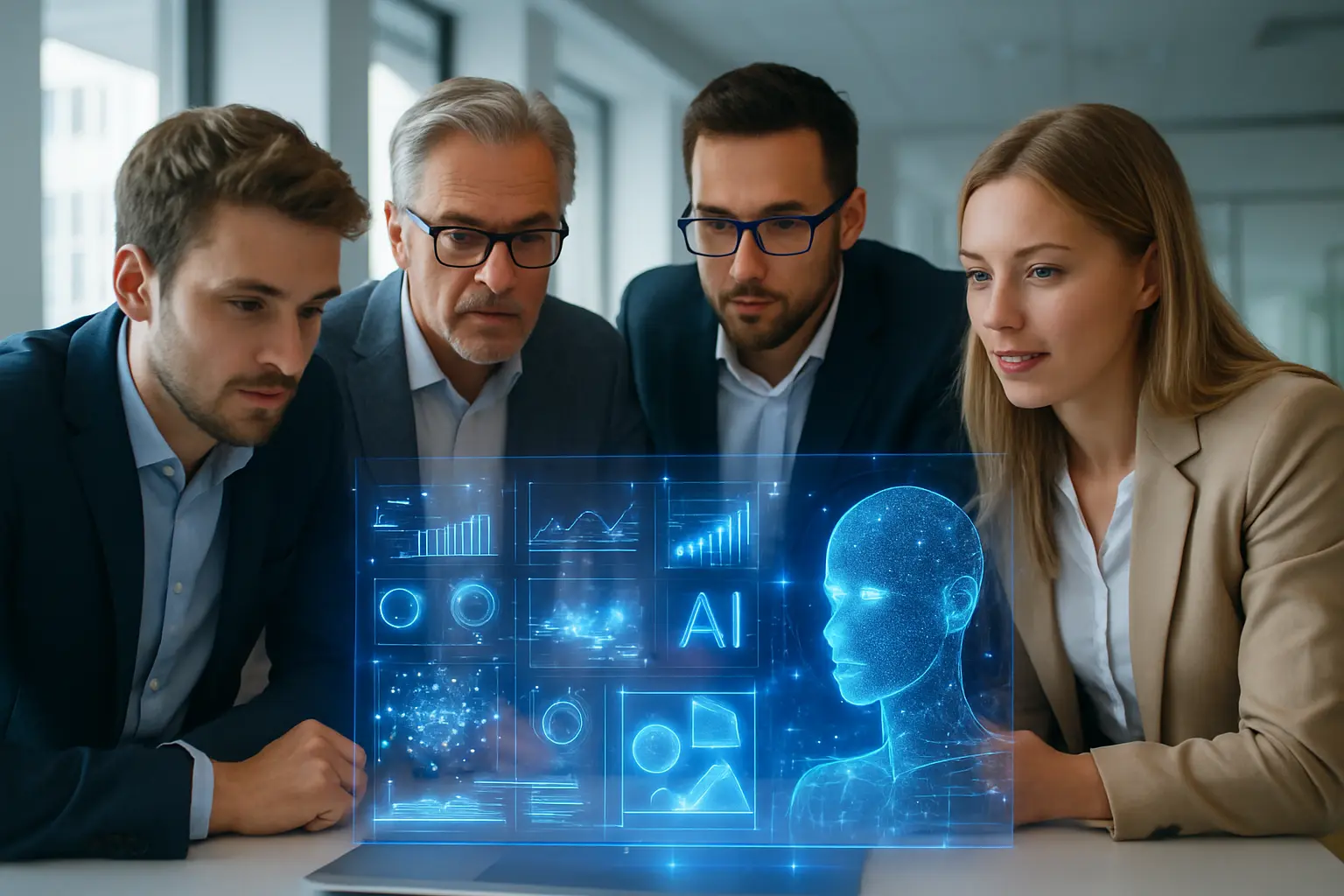
From Marketing Automation to True Marketing Autonomy
Current marketing automation platforms are powerful but are fundamentally based on predefined rules and triggers set by humans („If a user does X, then send them email Y”). The future is marketing autonomy. Autonomous systems will use AI and machine learning to make and execute decisions on their own to achieve a specified goal. For example, a marketer could set a goal of „acquire 1,000 new leads from the technology sector with a budget of $50,000 this quarter.”
The autonomous marketing platform would then:
- Analyze historical data to identify the most effective channels and audiences.
- Dynamically allocate the budget across channels like Google Ads, LinkedIn, and content syndication partners in real-time.
- Generate and A/B test hundreds of ad copy and creative variations.
- Adjust bidding strategies based on minute-by-minute performance.
- Reallocate budget away from underperforming channels and double down on what’s working, all without human intervention.
The marketer’s role transforms from a hands-on-keyboard campaign manager to a high-level strategist who sets the goals, defines the constraints (like brand safety guidelines), and monitors the AI’s overall performance. This frees up immense amounts of time for more strategic work, such as market research, competitive analysis, and creative brainstorming. Companies that leverage these autonomous systems will gain a significant competitive advantage in efficiency and campaign performance. Understanding these systems is part of the expertise available through platforms like MarketingV8.
Intelligent Reporting: From Historical Data to Predictive Analytics
Standard marketing dashboards are excellent at showing what has already happened. They report on last month’s website traffic, last week’s conversion rate, and yesterday’s click-through rates. While useful, this is like driving a car by looking only in the rearview mirror. The next generation of AI-powered analytics will focus on predictive and prescriptive insights.
Instead of just asking „How did our campaign perform?”, marketers will be able to ask, „Which of our current leads are most likely to convert in the next 30 days, and what actions should we take to increase that probability?” or „What is the projected ROI if we shift 20% of our budget from social media to search ads for the next quarter?” AI models will continuously analyze incoming data streams to forecast future trends, identify opportunities and threats, and recommend specific actions to optimize outcomes. This eliminates much of the guesswork from marketing planning and allows for more agile and confident resource allocation. Manual report generation will become a thing of the past, replaced by intelligent systems that surface the most critical insights and predictions directly to the relevant stakeholders. The goal is to make every marketing decision as informed as possible, a core tenet we follow in our projects at MarketingV8.
AI as a Partner in High-Level Strategic Decision-Making
Perhaps the most transformative prediction is the role AI will play not just in tactical execution but in high-level strategic planning. Major business decisions, such as entering a new market, launching a new product line, or undertaking a major rebranding, are fraught with risk and uncertainty. AI can act as a powerful decision-support tool by running complex simulations based on vast datasets.
Before launching a new product, an AI model could simulate thousands of market scenarios, factoring in competitor reactions, potential pricing strategies, consumer sentiment trends, and macroeconomic indicators to predict a range of potential outcomes. It could identify untapped audience segments that human analysis might miss or flag potential risks in a proposed marketing message before it ever goes public. AI can analyze decades of marketing case studies and academic research to provide evidence-based recommendations on branding, positioning, and go-to-market strategy. This doesn’t replace the need for human leadership and intuition, but it augments it with a powerful analytical engine, allowing leaders to make bold decisions with a much higher degree of confidence. The future CMO will not just be a creative and a leader but also a skilled operator of these strategic AI tools.
The impending wave of AI innovation promises a smarter, faster, and more effective future for marketing. From hyper-personalized content to autonomous campaigns and strategic foresight, the possibilities are immense. However, this future is not guaranteed. It requires a proactive approach from marketing leaders and their teams—a commitment to learning, adapting, and embracing new ways of working. The time to prepare is now.
Ready to explore how AI can transform your marketing strategy? Contact us today to start the conversation.
Dodaj komentarz