As we navigate the ever-accelerating currents of technological advancement, the conversation around Artificial Intelligence has fundamentally shifted. No longer a far-off concept from science fiction, AI is now a foundational pillar of modern business strategy. The questions businesses are asking have evolved from „Can AI do this?” to „How quickly, efficiently, and intelligently can AI integrate into our core operations?” Looking ahead to 2026, the expectations are not just for incremental improvements but for transformative changes across the entire business landscape. Companies anticipate an era where AI is not merely a tool but an intelligent partner, driving unprecedented levels of automation, enabling content creation at an unimaginable scale, accelerating the pace of business, and redefining the very nature of customer interaction. This is not about replacing human ingenuity but augmenting it, creating a symbiotic relationship where data-driven precision meets human creativity to unlock new frontiers of growth and innovation.
Table of Contents:
- The Dawn of Hyper-Automation: Beyond Simple Task Management
- Content at Scale: The AI-Powered Content Engine
- The Need for Speed: AI as a Catalyst for Business Velocity
The Dawn of Hyper-Automation: Beyond Simple Task Management
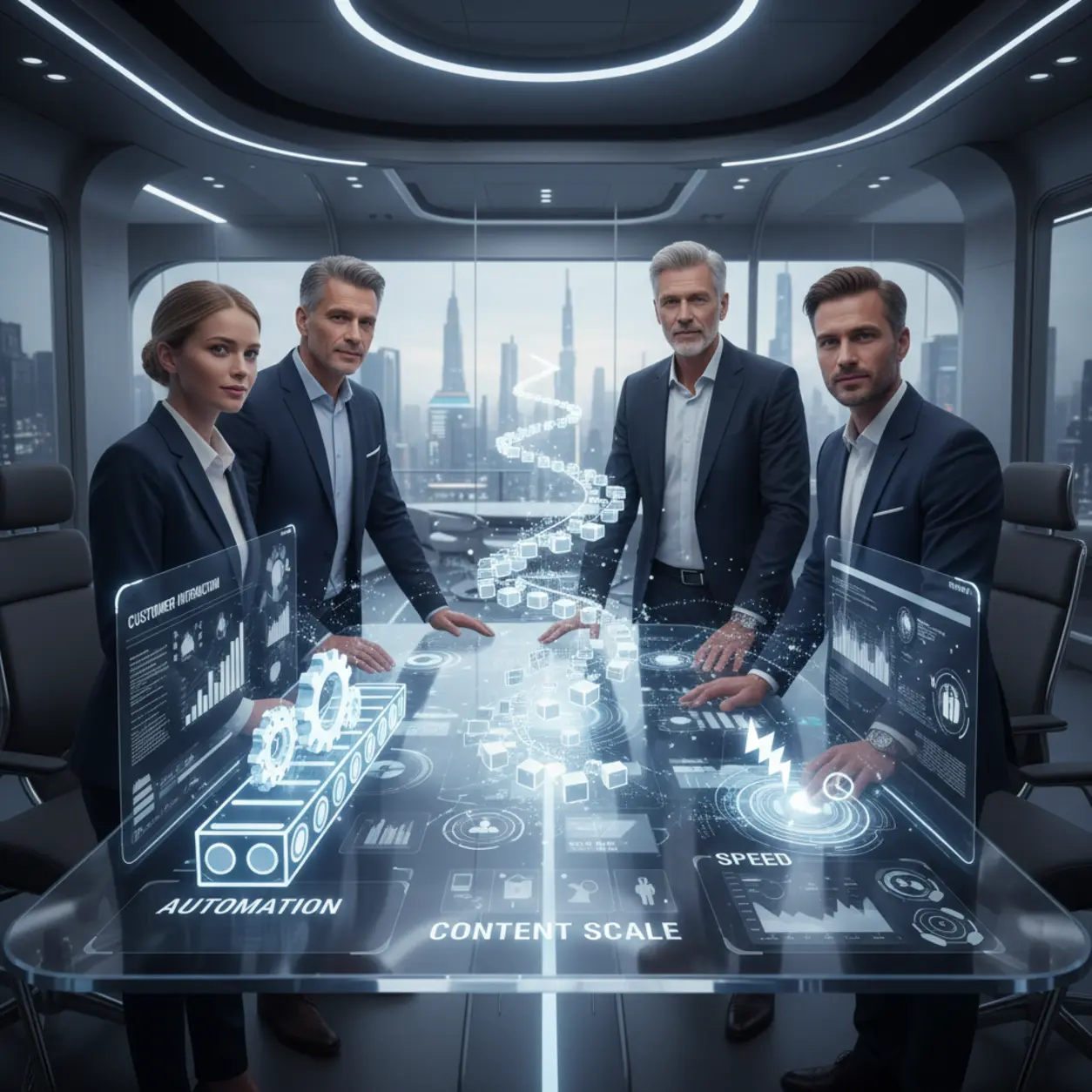
By 2026, the term „automation” will feel quaint and outdated. The business world will be fully immersed in the era of hyper-automation, a strategic approach where organizations rapidly identify, vet, and automate as many business and IT processes as possible. This goes far beyond the simple, rules-based task automation of the past. It involves the orchestrated use of multiple advanced technologies, including Artificial Intelligence, machine learning, and robotic process automation (RPA), to create a seamless, intelligent, and self-operating business ecosystem. The expectation is that AI will serve as the central nervous system, connecting disparate systems and making intelligent decisions without constant human intervention.
Intelligent Process Automation (IPA)
Intelligent Process Automation represents the evolution of traditional RPA. While RPA is excellent at mimicking repetitive human actions within a user interface, IPA infuses this capability with AI’s cognitive power. In 2026, businesses expect IPA systems to manage entire end-to-end workflows that require judgment and adaptation. For example, consider the customer onboarding process. A traditional automated system might send a welcome email. An IPA system, however, will initiate the process, analyze the customer’s submitted documents using Natural Language Processing (NLP) and computer vision, verify their identity against external databases, personalize their welcome kit based on their initial preferences, and schedule a follow-up call with a human agent only if an anomaly is detected. This creates a frictionless experience for the customer and frees up entire teams to focus on high-value relationship building. These integrated systems are the future of operational efficiency, a concept we explore deeply at MarketingV8.
Predictive Operations and Supply Chain Optimization
The supply chain has long been a complex web of logistics, inventory management, and forecasting. By 2026, businesses expect AI to transform it from a reactive to a predictive model. AI algorithms will continuously analyze vast datasets, including historical sales data, weather patterns, geopolitical events, social media trends, and sensor data from shipping containers. The result is a supply chain that can anticipate disruptions before they happen. For instance, an AI might predict a port closure due to an impending storm and automatically reroute shipments to an alternative port, simultaneously adjusting inventory levels and production schedules across multiple factories. It will forecast consumer demand for a specific product in a specific region with stunning accuracy, eliminating both stockouts and costly overstock situations. This level of foresight allows for unprecedented resilience and efficiency, turning the supply chain into a significant competitive advantage.
The Evolving Role of the Human Workforce
The rise of hyper-automation inevitably raises questions about the human role. The expectation for 2026 is not one of mass replacement but of profound augmentation. Repetitive, data-entry, and low-level decision-making tasks will be almost entirely handled by AI. This frees the human workforce to focus on tasks that require uniquely human skills: complex problem-solving, strategic thinking, creativity, empathy, and ethical oversight. The job of a marketing manager, for example, will shift from manually analyzing campaign data to defining strategic goals for an AI system that then executes, tests, and optimizes thousands of campaign variations in real-time. The human role becomes that of a conductor, orchestrating a powerful orchestra of AI tools to achieve a strategic vision.
„By 2026, the most valuable employees will not be the ones who can perform a task the best, but those who can best instruct an AI on how to perform it. The skill set is shifting from execution to orchestration and strategic oversight.”
This transition will require a significant investment in reskilling and upskilling, with a focus on data literacy, AI management, and critical thinking. Businesses that successfully manage this human-AI collaboration will foster a more engaged, innovative, and impactful workforce.
Content at Scale: The AI-Powered Content Engine
Content remains king in the digital marketing world, but the kingdom is expanding at an exponential rate. The manual, time-consuming process of content creation is no longer viable for businesses that want to compete. By 2026, companies expect AI to function as a full-fledged content engine, capable of producing high-quality, personalized, and strategically aligned content at a scale that is impossible for human teams to achieve alone. This is not about churning out generic articles; it is about creating a sophisticated, data-informed content ecosystem that speaks to every customer on an individual level.
From Generation to Hyper-Personalization
The initial wave of AI content generation focused on creating basic articles or product descriptions. By 2026, this will have evolved into hyper-personalization. AI systems will be deeply integrated with Customer Relationship Management (CRM) and Customer Data Platforms (CDP). They will analyze a user’s browsing history, purchase records, past interactions, and demographic data to dynamically generate content on the fly. Imagine a user visiting an e-commerce website. Instead of seeing a generic homepage, they are greeted with a personalized landing page featuring a blog post about the benefits of a product they recently viewed, customer testimonials from people in their demographic, and a video script generated in real-time highlighting the features most relevant to them. This „segment of one” marketing transforms content from a static asset into a dynamic, interactive experience, significantly boosting engagement and conversion rates. Understanding these advanced strategies is central to the mission of our agency.

SEO and Content Strategy Reimagined
AI’s role in Search Engine Optimization (SEO) will become far more strategic. Instead of just suggesting keywords, AI platforms in 2026 will be true strategic partners. They will perform comprehensive market analysis, identifying not just what competitors are ranking for, but predicting which topics will become relevant in the next six months. These tools will analyze the entire search engine results page (SERP) for a given query, deconstructing the intent behind it and recommending the optimal content format—be it a listicle, a how-to guide, a video, or an interactive tool. AI will be able to map out entire topic clusters and pillar pages, ensuring topical authority and building a formidable SEO moat. Furthermore, AI will automate the optimization process, A/B testing headlines, meta descriptions, and even internal linking structures at a massive scale to find the perfect combination for maximum visibility. This frees human strategists to focus on brand voice, overarching narrative, and high-level creative direction, a powerful synergy we champion at MarketingV8.
The Need for Speed: AI as a Catalyst for Business Velocity
In the digital economy, speed is not just a metric; it is a currency. The ability to analyze information, make decisions, and execute strategies faster than the competition is paramount. By 2026, businesses will rely on AI as the primary catalyst for increasing their operational velocity across all departments. From the C-suite to the development floor, AI will compress timelines and provide the real-time intelligence needed to navigate a rapidly changing market with agility and confidence.
Real-Time Data Analysis and Decision-Making
The days of waiting for monthly or quarterly reports to make strategic decisions will be a relic of the past. Businesses in 2026 expect AI-powered analytics platforms that process and interpret a constant firehose of data in real time. These systems will monitor sales figures, website traffic, social media sentiment, competitor pricing, and economic indicators simultaneously. An executive will be able to ask a natural language query like, „How did our latest promotion in the European market affect social media sentiment among 18-25 year olds, and what is the projected impact on Q3 revenue?” and receive an instant, comprehensive answer complete with data visualizations and predictive models. This capability for instantaneous insight empowers leaders to be proactive rather than reactive, spotting opportunities and mitigating risks as they emerge, not weeks after the fact. This agile approach is a core tenet of the solutions offered by top digital agencies like us.
Accelerated Product Development Cycles
The product development lifecycle, from ideation to launch, will be dramatically shortened by AI. Generative AI will assist engineers in writing and debugging code, creating initial design mockups, and even simulating thousands of prototype variations to identify the most viable option without building a physical model. During the testing phase, AI will analyze user feedback from beta testers, identifying common pain points and usability issues within hours instead of weeks. It can even predict which features are most likely to drive user adoption and satisfaction before a single line of code is written for them. This acceleration allows businesses to innovate more rapidly, respond to market feedback faster, and launch more refined products, ultimately gaining a significant time-to-market advantage.
Revolutionizing Customer Interactions with AI
The final, and perhaps most impactful, expectation for AI in 2026 lies in its ability to completely revolutionize customer interactions. The line between human and AI-powered support will become virtually indistinguishable for most inquiries. AI-driven chatbots and voice assistants will be available 24/7, but with capabilities far beyond simple FAQ responses. They will be equipped with advanced sentiment analysis, allowing them to detect a customer’s frustration or satisfaction and adjust their tone and approach accordingly. Integrated with the company’s full data ecosystem, these AI agents will have a complete view of the customer’s history. They will be able to proactively solve problems, for example, by noticing a customer is repeatedly visiting a help page and initiating a chat to offer assistance. They will handle complex tasks like rescheduling a delivery, processing a return, and offering a personalized discount on a future purchase, all within a single, seamless conversation. This not only improves customer satisfaction but also scales support operations in a way that is financially impossible with an all-human team. For more on building a future-proof business, explore the services at MarketingV8.
The journey to 2026 is one of integration and intelligence. The businesses that will thrive are those that see AI not as a series of disparate tools but as a cohesive, intelligent fabric woven into every aspect of their operations. The expectations are high, but the potential rewards—unmatched efficiency, profound customer connections, and unprecedented speed—are even higher. The future is not just automated; it is intelligent.
Ready to prepare your business for the AI revolution of 2026? Contact us today to learn how our solutions can put you ahead of the curve.
Dodaj komentarz