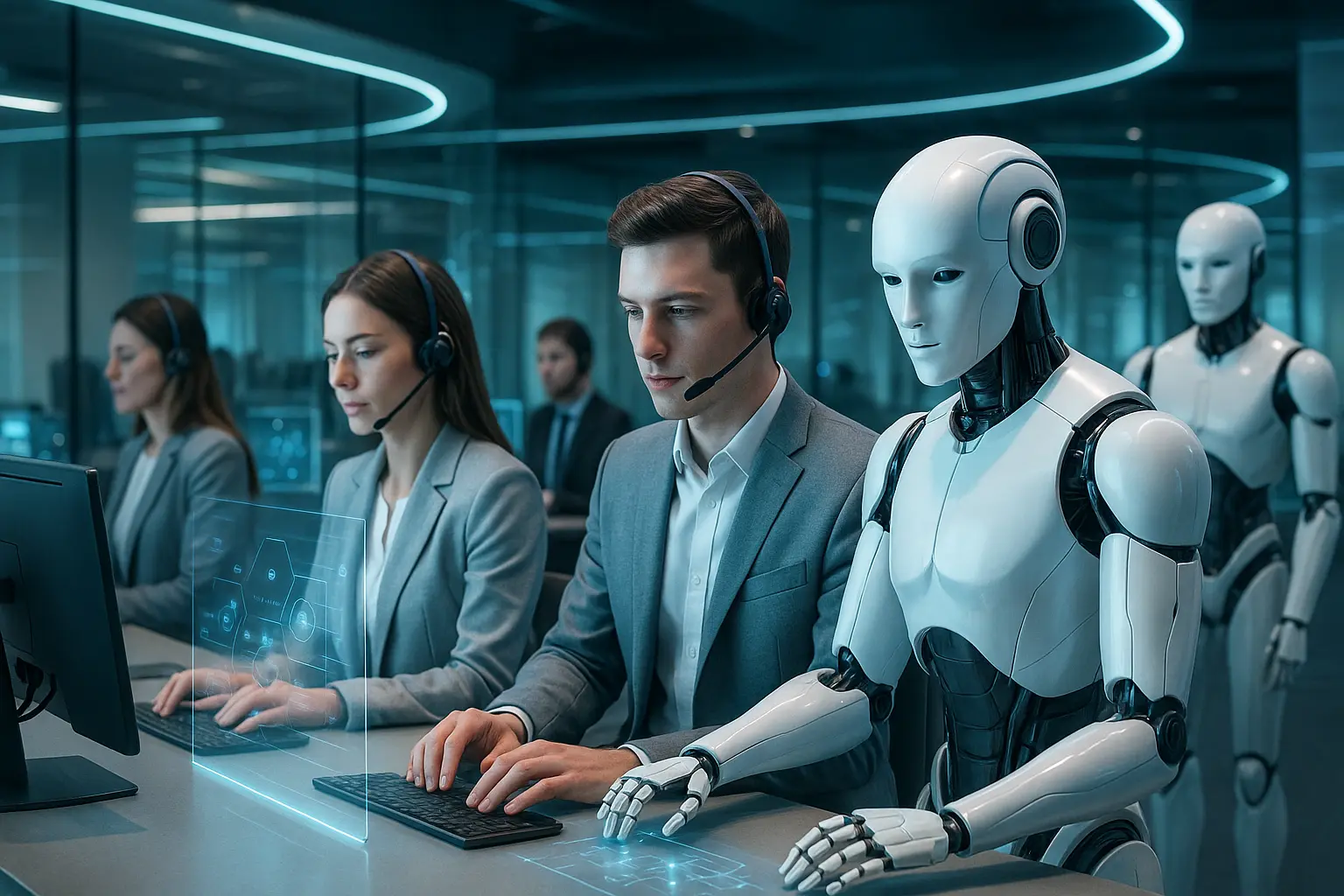
The landscape of customer support is undergoing a seismic shift, driven by the rapid advancements in Artificial Intelligence. Businesses are no longer asking if they should incorporate AI into their customer service, but rather how and where. The promise is tantalizing: 24/7 availability, instant responses, and significant cost reductions. However, the rush to automate everything can lead to a cold, impersonal customer experience that drives people away. The true art lies in finding the delicate balance between machine efficiency and human empathy.
Understanding which tasks are best suited for AI and which require the nuanced touch of a human agent is the cornerstone of a successful modern customer support strategy. It’s about creating a synergistic system where AI handles the repetitive and data-driven, freeing up human experts to manage the complex and emotional. This hybrid approach not only boosts operational efficiency but also elevates the customer journey, fostering loyalty and satisfaction. In this comprehensive guide, we will explore the ideal domains for AI automation in customer support and identify the critical areas where the human element must be preserved to ensure a superior experience.
Table of Contents:
- The AI Advantage: Tasks Primed for Automation
- The Irreplaceable Human Touch: Where Empathy and Expertise Shine
- Crafting the Perfect Hybrid Model: AI and Humans in Harmony
The AI Advantage: Tasks Primed for Automation
Artificial Intelligence excels at tasks that are repetitive, follow clear rules, and involve large amounts of data. By offloading these responsibilities to AI, businesses can create a more efficient, responsive, and scalable support operation. This not only improves key performance indicators but also enhances the work environment for human agents, allowing them to focus on more meaningful and challenging interactions. The goal is not to replace humans, but to empower them with a powerful tool that handles the groundwork.
24/7 Availability and Instant Responses for Common Queries
One of the most significant advantages of AI in customer support is its ability to operate around the clock without breaks. Modern customers expect immediate answers, regardless of the time of day or their geographical location. An AI-powered chatbot or virtual assistant can provide instant responses to frequently asked questions (FAQs) at any hour. This is a game-changer for global businesses and those operating outside standard 9-to-5 working hours.
Consider queries such as:
- „What are your business hours?”
- „What is your return policy?”
- „Where can I track my order?”
- „Do you ship to my country?”
These are straightforward questions with standardized answers. Forcing a customer to wait in a queue or send an email for this information creates unnecessary friction. An AI can access a knowledge base in milliseconds and provide an accurate, helpful answer instantly. This immediate gratification significantly improves the customer experience for simple inquiries and filters out a large volume of basic requests that would otherwise clog up the support channels. This strategy is a core component of the services offered by forward-thinking agencies like MarketingV8, where efficiency is paramount.

Intelligent Data Collection and Ticket Routing
Before a human agent can even begin to solve a problem, they often need to gather preliminary information. This can be a time-consuming process involving questions like „Can I have your order number?”, „What is the email address associated with your account?”, or „Could you describe the issue you’re experiencing?”. AI can automate this entire data collection phase.
An intelligent chatbot can act as a digital concierge, greeting the customer and gathering all necessary details upfront. Once the information is collected, the AI can use natural language processing (NLP) to analyze the customer’s issue and automatically route the ticket to the most appropriate department or agent. For example, a query containing the words „billing error” and „invoice” can be sent directly to the finance department, while a message with „product not working” and „error code” can be routed to the technical support team. This intelligent routing eliminates the need for a human to manually triage incoming requests, which reduces response times and ensures the customer is connected with the right expert from the very beginning.
Handling High-Volume, Repetitive Tasks
Every support team deals with a set of recurring tasks that, while simple, consume a significant amount of agent time and energy. These are prime candidates for automation. Tasks like password resets, updating contact information, processing simple refunds based on predefined rules, or canceling a subscription fall into this category. Automating these processes not only frees up human agents but also empowers customers with self-service options that they often prefer for simple actions.
By automating routine requests, you’re not just saving costs; you are investing in your human agents’ job satisfaction. You’re allowing them to move from being script-readers to becoming true problem-solvers, which increases employee retention and the quality of customer interactions.
For example, a customer who forgot their password can interact with a bot that verifies their identity through a series of security questions or a two-factor authentication code sent to their phone, and then guides them through the reset process. This entire interaction can be completed in under a minute, without any human intervention. This level of efficiency is a key focus for any modern business aiming to scale its operations, a principle well understood by experts at MarketingV8 who design streamlined customer journeys.
The Irreplaceable Human Touch: Where Empathy and Expertise Shine
While AI is a powerful tool for efficiency, it has its limitations. It lacks genuine empathy, creativity, and the ability to understand complex, nuanced human emotions. There are critical moments in the customer journey where automation can do more harm than good. In these situations, the skill, understanding, and personal connection offered by a human agent are not just preferable—they are essential for retaining customers and protecting the brand’s reputation.
Complex, Multi-Layered Problem Solving
Some customer issues are not straightforward. They may involve multiple interconnected problems, require investigation across different systems, or have no precedent in the company’s knowledge base. These are the scenarios where human critical thinking and problem-solving skills are indispensable. An AI operates based on scripts and data it has been trained on; it cannot „think outside the box” to devise a novel solution.
Imagine a customer whose order was damaged in transit, but the replacement item is now out of stock, and they need it for an important event. This situation requires a human agent who can empathize with the customer’s urgency, check inventory forecasts, perhaps coordinate with a local store, offer a suitable alternative, and potentially provide a credit for the inconvenience. A bot would likely hit a dead end, stating the item is out of stock and offering a standard refund, which would fail to address the customer’s core need and result in immense frustration. Human agents can navigate ambiguity and make judgment calls that are far beyond the current capabilities of AI. Developing a comprehensive digital strategy, which includes mapping these complex customer journeys, is a crucial service that can be explored further at MarketingV8.

Managing Emotionally Charged and Sensitive Situations
This is arguably the most important area to reserve for human interaction. When a customer is angry, frustrated, confused, or distressed, the last thing they want is to interact with a machine that responds with scripted, emotionless phrases. These high-stakes conversations require empathy, active listening, and the ability to de-escalate a tense situation. A human agent can say, „I understand how frustrating this must be, and I am truly sorry for the trouble this has caused. Let’s work together to fix this.” This simple expression of genuine empathy can completely change the tone of the conversation and make the customer feel heard and valued.
Sensitive issues, such as discussing a significant billing error, reporting a security breach on an account, or dealing with the non-delivery of a high-value item, demand a level of trust and reassurance that only a human can provide. Trying to automate these interactions is a direct path to customer churn. The goal is to build relationships, and relationships are built on trust and human connection, not automated scripts.
Crafting the Perfect Hybrid Model: AI and Humans in Harmony
The most effective customer support strategy is not a choice between AI and humans, but rather an integration of both. The hybrid model leverages the strengths of each—AI for speed and data processing, and humans for empathy and complex problem-solving. This creates a seamless and intelligent support ecosystem that is greater than the sum of its parts. Leading digital agencies like MarketingV8 often advocate for such integrated systems.
AI as a Powerful Co-pilot for Human Agents
Even when a customer is speaking with a human agent, AI can play a vital role behind the scenes. AI tools can act as a „co-pilot” for support staff, dramatically enhancing their efficiency and effectiveness. During a call or chat, an AI can analyze the conversation in real-time and provide the agent with relevant information from the knowledge base, customer history, and order details. This means the agent doesn’t have to put the customer on hold while they search for information.
Furthermore, AI can suggest potential responses or solutions, which the agent can then personalize. After the interaction, AI can automate post-call work, such as summarizing the conversation, creating a ticket, and updating the CRM. This frees the agent to move to the next customer more quickly, reducing wait times for everyone. It’s a powerful combination of human soft skills and machine-powered data retrieval.
Designing Seamless Handoffs from Bot to Human
One of the biggest frustrations for customers is having to repeat themselves. A poorly designed hybrid system can create this exact problem. A customer might spend several minutes explaining their issue to a chatbot, only to be transferred to a human agent who asks, „So, how can I help you today?” This is a critical failure point.
A well-designed system ensures a seamless handoff. When the AI determines that human intervention is needed, it should automatically transfer the entire conversation history, along with all the data it collected (customer name, account number, issue summary), to the human agent. The agent can then enter the conversation fully informed, saying, „Hello, I see you were talking with our bot about an issue with your recent order. I have all the details here, and I’m ready to help you solve it.” This simple step transforms the customer experience from one of frustration to one of relief and confidence. It shows the customer that the company values their time and has a cohesive support system. The architecture of such seamless systems is a core part of the digital transformation services available to businesses today.
Creating a Cycle of Continuous Improvement
A hybrid model also creates a powerful feedback loop for continuous improvement. The interactions handled by human agents, especially the resolution of complex cases, can be used to train and improve the AI model. By analyzing the successful solutions provided by top-performing agents, the AI can learn to handle a wider range of queries in the future. Similarly, data from the chatbot can reveal common customer pain points or gaps in the knowledge base, providing valuable insights to the support and product teams.
This symbiotic relationship ensures that the entire support operation becomes smarter and more effective over time. The AI gets better at handling simple issues, which allows human agents to specialize further in high-value, complex support, ultimately leading to a more knowledgeable and capable team and a more satisfied customer base.
In conclusion, the integration of AI into customer support is not about replacing the human workforce but about augmenting it. By strategically automating the right tasks—the repetitive, the data-driven, and the after-hours—businesses can unlock incredible efficiency and provide the instant support that customers crave. At the same time, by reserving complex, emotional, and high-stakes interactions for skilled human agents, they can build stronger relationships and foster lasting loyalty. The future of customer service is a thoughtful collaboration between human intelligence and artificial intelligence, working in concert to deliver an experience that is both efficient and deeply human.
Ready to find the perfect AI and human balance for your customer support? Contact us today to discuss how we can help you design a modern, efficient, and customer-centric support strategy.
Dodaj komentarz